
Personalization drives results. Marketing leaders know this.
Localized messaging increases engagement, improves conversion rates, and strengthens customer loyalty. But when you’re responsible for dozens, or hundreds, of locations, personalization quickly becomes an operational nightmare.
If you manage 100 locations and launch at least one campaign per month, you’re not managing one campaign; you’re managing 100 variations. Multiply that across email, direct mail, social media, digital ads, and in-store signage, and the workload grows exponentially.
The problem isn’t that personalization doesn’t work. The problem is that traditional production models weren’t designed to scale it.
Hiring more designers or coordinators might relieve pressure temporarily, but it doesn’t solve the underlying inefficiency. To scale personalization sustainably, marketing leaders must shift from manual production to automated enablement.
Here’s how to do it.
The Core Challenge: Balancing Local Relevance with Brand Control
Multi-location marketing leaders face a constant tension between two priorities:
- Local teams need flexibility to respond to their market
- Corporate teams need consistency to protect brand integrity and compliance
Without the right infrastructure, organizations typically fall into one of two traps:
The Bottleneck Model
Corporate marketing reviews every asset variation. Requests pile up. Campaigns slow down. Local teams miss opportunities.
The Wild West Model
Corporate distributes editable files and hopes for the best. The result: inconsistent branding, compliance risks, and fragmented customer experiences.
Neither model is scalable. The solution is not more oversight or less control—it’s smarter systems.
Scaling personalization requires building a framework where localization happens automatically within predefined guardrails.
Automate the Production Work That Drains Your Team
One of the biggest sources of burnout in distributed marketing teams is repetitive manual work, changing phone numbers, updating addresses, or swapping location-specific offers.
These tasks don’t require creative expertise, but they consume valuable creative resources.
Automation solves this problem.
Use Modular Templates to Scale Faster
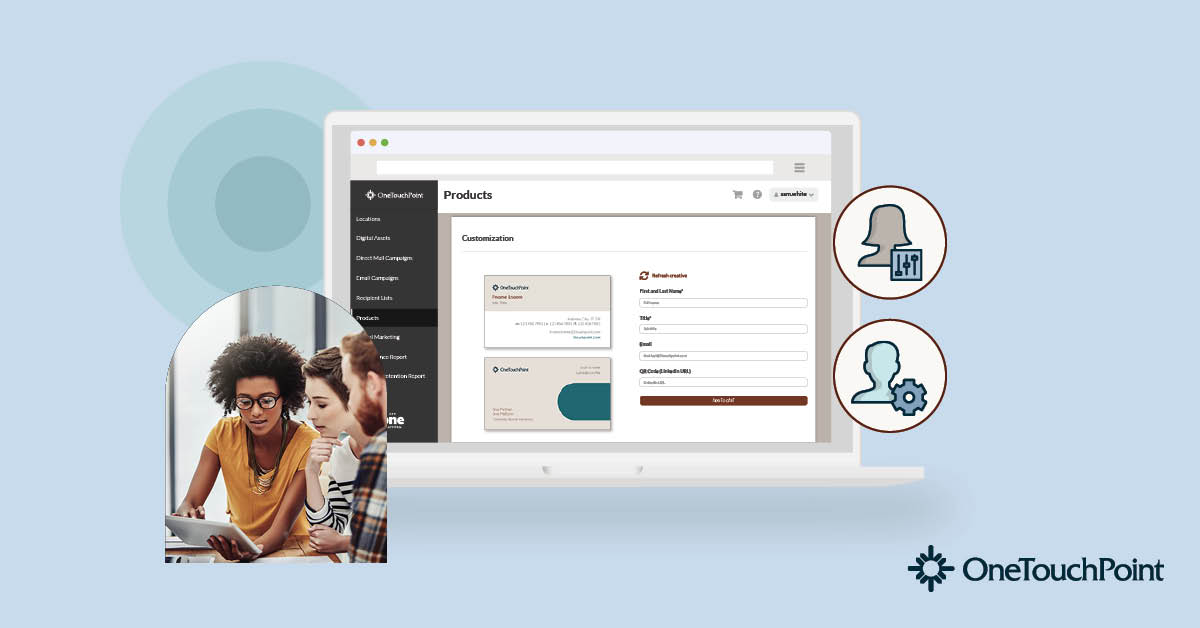
Modular templating allows marketing leaders to create pre-approved assets with locked brand elements while enabling controlled local customization.
Core brand elements remain fixed:
- Logos
- Typography
- Colors
- Legal disclaimers
- Campaign messaging
Customizable fields update automatically using location data:
- Address
- Phone number
- Store hours
- Regional offers
This eliminates manual versioning entirely. Local teams generate compliant, personalized assets instantly, all without requiring corporate intervention.
Creative teams regain time to focus on strategy instead of production.
Centralize Assets to Eliminate Operational Chaos
When assets live across email threads, shared drives, and outdated folders, teams waste time searching, verifying, and correcting files.
A centralized asset management system provides a single source of truth for:
- Brand assets
- Campaign templates
- Approved imagery
- Compliance-approved messaging
This ensures every location uses current, approved materials, reducing errors, rework, and brand risk.
Just as importantly, it removes friction that slows campaign execution.
Streamline Workflows with Tiered Permissions and Automated Approvals
Approval bottlenecks are one of the biggest hidden drivers of marketing team burnout.
When every minor change requires executive review, teams become overwhelmed and campaigns stall.
A tiered permission model solves this by aligning oversight with risk level.
Tier 1: Fully Automated
Pre-approved templates with auto-populated location data. No approval required.
Tier 2: Local Customization with Guardrails
Limited customization using approved copy and imagery. Local manager approval only.
Tier 3: Corporate Review Required
New creative concepts, brand updates, or high-visibility campaigns.
This structure removes unnecessary approvals from routine workflows while maintaining full brand control where it matters most.
The result is faster execution and dramatically reduced operational strain.
Focus Personalization Where It Actually Drives ROI
Not every marketing channel benefits equally from localization.
High-performing marketing teams prioritize personalization where it produces measurable business impact.
For example:
High-impact personalization channels:
- Direct mail with local offers and maps
- Location-specific landing pages
- Regional promotions
- Event marketing materials
Lower-impact personalization channels:
- Minor social media graphics
- Internal communications
- Generic brand awareness creative
Prioritizing high-impact channels allows teams to maximize results without overextending resources.
Scale Personalization Through Smart Segmentation
True scalability doesn’t always require unique content for every individual location.
Segmenting locations into logical groups (based on geography, demographics, or performance) can deliver most of the benefits of personalization with far less complexity.
Instead of creating 500 versions of a campaign, marketing teams might create:
- Regional variations
- Climate-based versions
- Urban vs. suburban messaging
- Performance-based tiers
This approach balances efficiency and relevance.
Empower Local Teams Without Increasing Corporate Workload
Technology alone doesn’t solve scaling challenges. Adoption does.
When local teams have intuitive tools and clear guidelines, they can execute marketing independently without relying on corporate support.
Effective enablement includes:
- Simple user interfaces
- Pre-approved templates
- Short training videos
- Clear brand guardrails
Empowered local teams accelerate campaign execution while reducing central team workload.
This transforms distributed marketing from a bottleneck into a force multiplier.
Unified Platforms Are the Foundation for Scalable Personalization
Many marketing teams rely on disconnected tools for asset storage, creative production, approvals, and fulfillment.
This fragmentation creates inefficiencies, errors, and manual coordination.
Unified marketing resource management platforms integrate these functions into a single system, allowing:
- Centralized brand management
- Streamlined approvals
- Direct ordering and fulfillment
This eliminates operational friction and enables scalable personalization across locations.
Scaling Personalization Sustainably with OTP One
Scaling personalization isn’t just a creative challenge; it’s an infrastructure challenge.
OTP One is purpose-built to help multi-location marketing teams automate, standardize, and scale localized marketing without increasing workload.
With OTP One, organizations can:
- Create dynamic, brand-compliant templates
- Automate approvals and workflows
- Centralize assets and brand management
- Enable local teams to execute independently
- Maintain full brand control across every location
Instead of acting as production coordinators, corporate marketing teams can focus on strategy, growth, and performance.
That’s how personalization scales sustainably.
Key Takeaway for Marketing Leaders
Scaling personalization isn’t about doing more work—it’s about eliminating manual work.
When you combine automation, centralized control, and local enablement, you create a system where personalization happens efficiently, consistently, and without burnout.
The organizations that win in multi-location marketing aren’t the ones with the biggest teams.
They’re the ones with the smartest systems.