
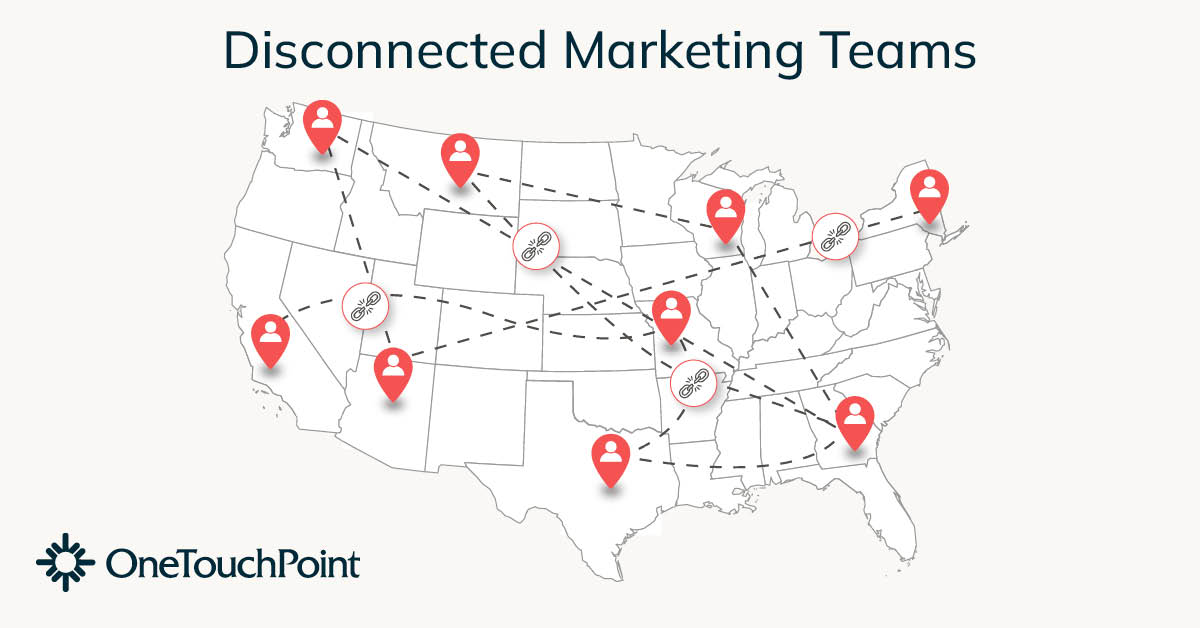
Most marketing leaders don’t realize how much disconnected teams are costing them.
The impact isn’t always obvious in quarterly reports. It shows up in duplicated work, inconsistent campaigns, missed opportunities, and slow execution. Over time, these inefficiencies quietly erode marketing performance, inflate operational costs, and weaken brand trust.
For multi-location organizations, the risk is even greater. Corporate, regional, and local teams often operate independently, using different tools, assets, and workflows.
What looks like decentralization for flexibility often becomes fragmentation. And fragmentation is expensive.
Here’s where disconnected marketing teams create hidden costs, and how leading organizations solve the problem.
Cost #1: Wasted Budget from Redundant and Uncoordinated Campaigns
When marketing teams operate without shared visibility, duplication becomes inevitable.
Multiple teams may target the same audience with overlapping campaigns across different channels, digital, direct mail, social media or print, without coordination.
This results in:
- Duplicate production costs
- Inefficient media spend
- Conflicting campaign timing
- Diluted messaging impact
Instead of reinforcing a unified brand message, campaigns compete against each other. Marketing dollars work harder, but accomplish less.
Centralized planning and shared systems allow organizations to coordinate campaigns strategically, improving efficiency and maximizing return on marketing investment.
Cost #2: Reduced Campaign Performance from Inconsistent Messaging
Consistency is one of the most powerful drivers of marketing effectiveness.
When customers encounter different messaging across email, digital ads, in-store displays, and local promotions, it creates confusion and weakens trust.
This inconsistency reduces:
- Customer engagement
- Conversion rates
- Brand credibility
- Campaign effectiveness
Disconnected teams unintentionally create fragmented customer experiences because they lack access to shared messaging frameworks and approved assets.
Unified marketing execution ensures every touchpoint reinforces the same brand narrative, strengthening customer confidence and improving performance.
Cost #3: Significant Productivity Loss from Duplicate Work
One of the most overlooked costs of disconnected teams is wasted time. McKinsey Global Institute found that employees spend 20% of their week searching for internal information or colleagues to help with a task.
Without centralized asset management, teams frequently recreate materials that already exist (often because they cannot find them or do not know they exist).
Common examples include:
- Redesigning brochures
- Recreating social media graphics
- Rebuilding presentations
- Producing duplicate campaign assets
This unnecessary production consumes creative resources that should be focused on strategic initiatives. Instead of driving innovation, creative teams become production bottlenecks.
Centralized asset libraries eliminate duplication and dramatically improve team productivity.
Cost #4: Slower Time-to-Market That Limits Competitive Advantage
Speed is a competitive advantage in modern marketing.
Disconnected workflows slow everything down.
Manual approval processes, scattered feedback, and unclear ownership create delays at every stage of campaign execution.
Marketing teams waste time:
- Tracking approvals across email threads
- Searching for the correct files
- Coordinating across multiple systems
- Resolving brand compliance issues
These delays prevent organizations from responding quickly to market opportunities.
Unified workflows accelerate execution, enabling marketing teams to launch campaigns faster and more efficiently.
Cost #5: Brand Inconsistency That Erodes Trust and Creates Risk
For multi-location brands, consistency is critical. Customer expectations have evolved. Salesforce reports that 90% of customers expect consistent interactions across channels, yet disconnected teams make delivering that consistency extremely difficult.
When local teams operate without centralized tools and guardrails, brand standards inevitably drift.
This leads to:
- Improper logo usage
- Inconsistent visual identity
- Unapproved messaging
- Compliance risks in regulated industries
Customers experience these inconsistencies immediately, even if they cannot articulate them. Trust weakens when brands appear fragmented.
Centralized brand management ensures every customer interaction reflects the same professional, trusted brand.
Cost #6: Lack of Visibility into Marketing Performance
Disconnected teams often rely on disconnected reporting.
Without centralized visibility, marketing leaders cannot fully understand:
- Which assets perform best
- Which campaigns drive revenue
- Where inefficiencies exist
- How resources are being used
This makes it difficult to optimize strategy or allocate budget effectively.
Unified systems provide the visibility needed to make smarter, data-driven decisions.
Why Disconnected Marketing Teams Are Especially Risky for Multi-Location Brands
The complexity of distributed marketing amplifies these challenges.
Every additional location introduces:
- More users
- More assets
- More campaigns
- More potential inconsistencies
Without centralized infrastructure, marketing operations become increasingly difficult to manage and scale.
What begins as a coordination challenge becomes a structural limitation on growth.
How Leading Marketing Organizations Solve the Problem
High-performing marketing teams don’t rely on manual coordination. They build centralized systems that unify brand management, creative execution, and local marketing.
This allows organizations to:
- Centralize brand assets and ensure consistency
- Enable local teams to execute marketing independently within guardrails
- Eliminate redundant production work
- Automate workflows and approvals
- Improve speed, efficiency, and campaign performance
Instead of operating as disconnected teams, marketing becomes a coordinated growth engine.
How OneTouchPoint Helps Unify Marketing Teams and Reduce Costs
OTP One is designed specifically to solve the operational challenges of distributed marketing. The platform centralizes brand management, creative automation, and local execution into a single, unified environment.
With OTP One, marketing leaders can:
Centralize Brand Assets
Provide a single source of truth for logos, templates, imagery, and marketing materials—ensuring consistency across every location.
Eliminate Duplicate Work
Enable teams to access and customize approved templates instead of recreating assets from scratch.
Streamline Workflows and Approvals
Automate approvals and reduce manual coordination, accelerating campaign execution.
Empower Local Teams While Maintaining Control
Allow local teams to create compliant marketing materials independently within brand guardrails.
Improve Marketing Efficiency and Reduce Costs
Eliminate waste, improve productivity, and maximize marketing ROI across the organization.
By unifying marketing operations, OTP One transforms fragmented execution into a scalable, efficient system.
The Path to More Efficient, Scalable, and Consistent Marketing
Disconnected marketing teams don’t just create operational frustration. They create measurable financial loss.
Wasted budget. Slower execution. Reduced performance. Brand inconsistency. These hidden costs compound over time.
Marketing leaders who centralize brand management, unify workflows, and enable coordinated execution don’t just improve efficiency. They unlock scalability, consistency, and stronger marketing performance.